
The most common question students ask before JAMB is not "what should I study?" It is "where do I even start?"
An entire syllabus — four subjects, hundreds of topics, thousands of possible questions — is overwhelming. So most students do what feels productive: they open a textbook somewhere in the middle, read until they are tired, and call it studying. They repeat this for months. They walk into the exam hall feeling like they worked hard. The results tell a different story.
Related: the official JAMB syllabus for all 15 subjects and formula sheets — free study resources that pair with this plan.
As our research on the West African education crisis shows, ~82% of UTME candidates scored below 200 in 2026. The system is overloaded, classrooms are overwhelmed, and passive study habits — reading and highlighting — have been proven by decades of cognitive science to be among the least effective ways to learn.
Project 320 Challenge is the answer to "where do I start?" It was designed for students who understand that beating the odds requires more than hope. It requires a programme. Do it solo — your daily plan, your pace. Or bring friends — Project 320 Challenge runs on Tenkobo's Study Groups, so you and your classmates can follow the same plan together, keep each other accountable, and compete on who stays on track.
How It Works: The 6+1 Weekly Rhythm
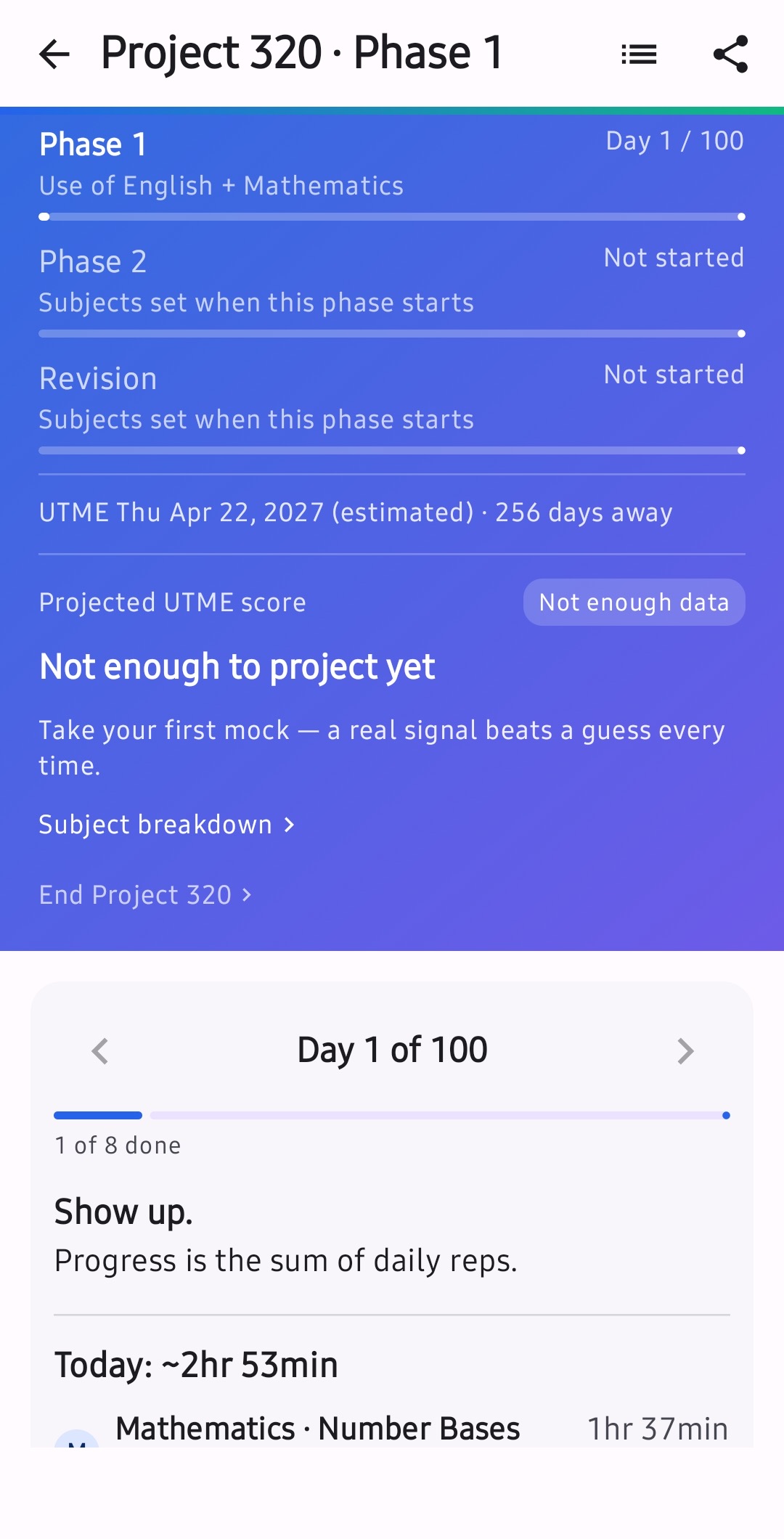
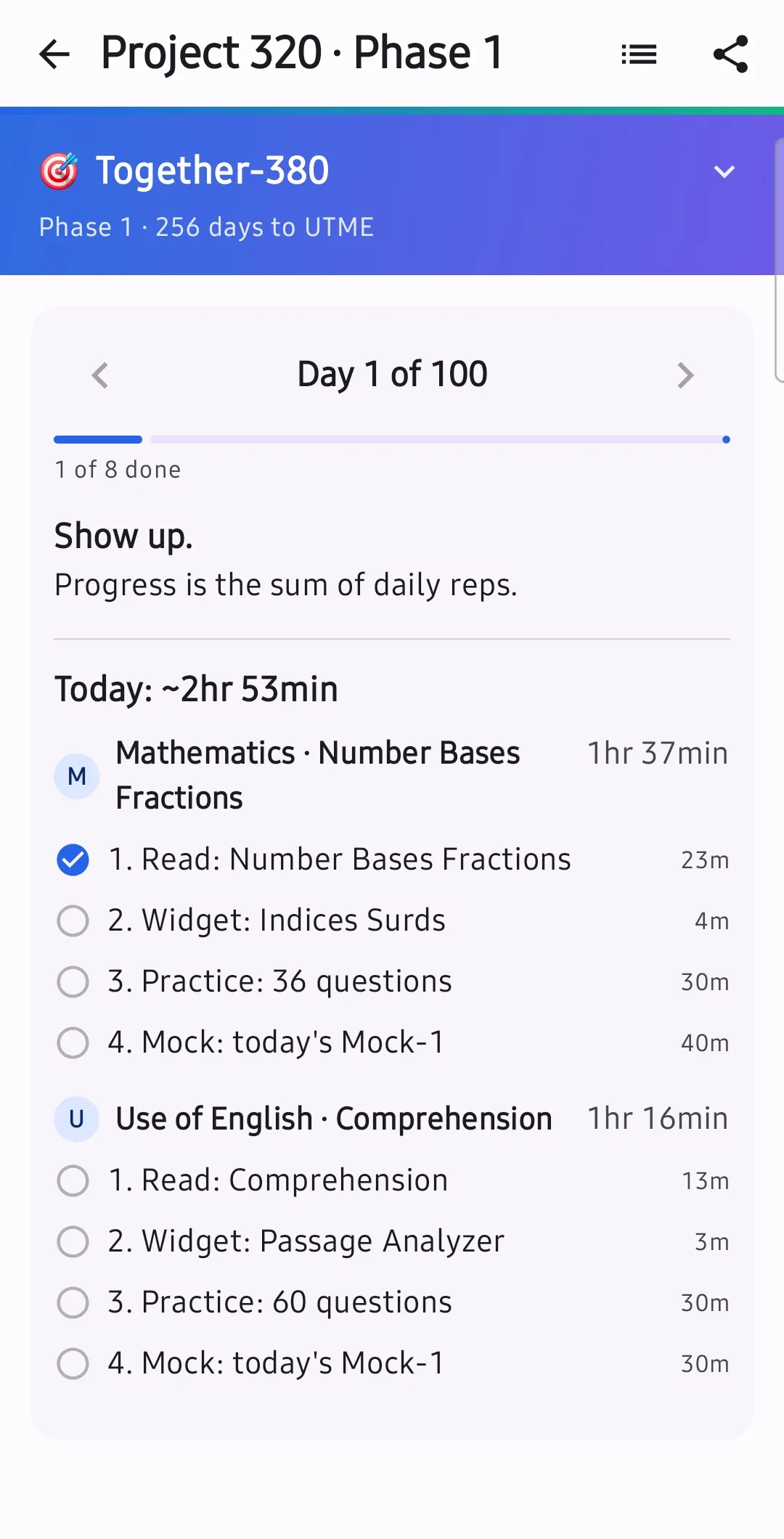
Project 320 is not a collection of study tips. It is a daily plan — specific, sequenced, and paced by an engine that understands how memory works. Every morning, you open your dashboard and see exactly what to do across your subjects. Every task links directly into Learn. Complete it. Return. It is marked done. No ambiguity. No "I'll figure it out later."
6 Focus Days
New content every day. Keypoint reading (revision notes crafted for your syllabus). Interactive widgets that make abstract concepts tangible. Textbook sections with guided reading. Practice questions with time budgeted for both attempting and reviewing wrong answers. Flashcards driven by the same SM-2 spaced repetition algorithm used by medical students worldwide. ~3-4 hours per day across 2 subjects. Sustainable. Not exhausting.
1 Rest Day (Every 7th Day)
Not a day off. A day of consolidation. Full mock exams under timed conditions, exactly like the CBT hall. Revision blocks targeting your weakest areas. Flashcards cycling through everything covered so far. This is where the learning locks in. During the final 30-day Revision phase, there are no rest days — every single day is retention work.
Three Phases, One Trajectory
First-Exposure (Days 1-100)
Two subjects. Full syllabus coverage. Every topic gets keypoints, widgets, textbook sections, practice questions, and flashcards. Rest days bring mock exams that build the feedback loop: study → test → see what you missed → fix it. By day 100, both subjects have been covered, reviewed, and tested multiple times.
Subject Rotation (Days 101-200)
Two new subjects enter active focus. Phase 1 subjects move into maintenance mode — regular mock exams and flashcards keep them sharp without consuming focus-day bandwidth. From week 7 of Phase 2, the new subjects also begin full mock exams. By day 200, all four subjects have been covered, tested, and reinforced. Nothing has been crammed.
Revision (Days 201-230)
30 days. No rest days. No new content. Pure retention. Mock exams across all four subjects. Wrong-answer replay. Targeted flashcard review. This is not cramming — it is the final consolidation of 200 days of structured work. By the time you reach exam day, every subject has been covered, reviewed, and tested repeatedly. The CBT hall feels familiar because you have been training in it for months.
The Engine Under the Hood
Project 320 is not a fixed schedule that hands every student the same tasks. It adapts. Here is what drives it:
SM-2 Spaced Repetition
Cards you struggle with reappear frequently. Cards you master graduate to longer intervals. The system adapts to your memory — not a fixed schedule. This is the same algorithm that powers Anki and medical school flashcard systems worldwide.
Rotation Baseline
Beyond what the algorithm flags for review, the system ensures you never miss an unseen card. Every flashcard in the bank — up to 1,800 per subject — is cycled through during Phase 1 and Phase 2. Nothing falls through the cracks.
UTME Projection
After every mock exam, the system updates a projected UTME score with a confidence rating — insufficient data → low → medium → high. Per-subject breakdowns show which topics are pulling your score down. You stop wondering if you are ready and start seeing the answer.
Why Your UTME Score Compounds
Why "Project 320 Challenge"?
320 out of 400 on JAMB UTME — the score that opens the door.
A UTME score is not just a number. It is the first domino. It determines which course you can study. Which course determines which scholarships you qualify for. Which scholarships determine whether you graduate with debt or with savings. Which institution determines your network, your first internship, your first job.
Hit 320+ and you are in the conversation for Medicine, Law, Engineering, and other competitive programmes at top federal universities — the programmes that attract the most scholarships, the best faculty, and the strongest alumni networks. From there: internships at multinationals, postgraduate funding abroad, job offers before graduation. The score opens the door. What you do after is up to you. But the door must open first.
Fall short, and the path narrows quickly. A score below 200 locks you out of most federal universities entirely. You settle for a course you did not want, at an institution you did not choose. The scholarships that could have changed your trajectory? Not available for that programme. The graduate recruitment pipelines that feed into the best firms? They recruit from the schools you could not get into. The gap does not close on its own. It compounds.
This is not about intelligence. It is about which side of the line you land on — and that line is drawn by one exam, on one day, in one CBT hall. Project 320 Challenge exists so that when that day comes, you are on the right side of it.
Who the Project 320 Challenge Is For
Project 320 is built for the student who has decided to go all-in. It assumes 3-8 hours of daily availability and treats Tenkobo as the primary study environment — not a supplement, but the backbone of your preparation. It is ideal for:
- UTME retakers — students who have been through the exam before, understand the stakes, and want a programme, not another set of past questions.
- Gap-year candidates — students taking a dedicated preparation year with structured time available.
- Full-time prep students — anyone who can commit 3-8 hours a day and wants a system that makes every hour count.
A future variant will serve current secondary students balancing school with 2-4 hours of daily prep. The programme adapts. Two additional modes — the 100-Day Challenge and 30-Day Revision — are available for students with less time.
Solo or with friends: Project 320 Challenge is built on Tenkobo's Study Groups infrastructure. Follow the plan on your own, or create a Study Group with classmates — same daily tasks, shared accountability, and friendly competition to see who stays on track. Getting through 230 days is easier when you are not doing it alone.
Why This Approach Works
Project 320 is built on four principles backed by decades of cognitive science:
Spacing, Not Cramming
The spacing effect — one of the most robust findings in psychology — shows that information reviewed at intervals is retained far longer than information crammed in a single session. Project 320 spaces every topic, every flashcard, and every mock exam across 230 days.
Active Recall Over Passive Review
Dunlosky et al. (2013) found that retrieval practice — forcing yourself to recall information from memory — is approximately 50% more effective than re-reading. Every component of Project 320 — flashcards, practice questions, mock exams — is built around retrieval. You are not passively reviewing. You are actively reconstructing knowledge.
Mixed Practice Over Blocked Practice
Studying one topic to exhaustion before moving to the next — blocked practice — feels productive but produces fragile learning. By rotating subjects across phases and interleaving flashcards, Project 320 forces your brain to discriminate between concepts. This builds more durable, transferable knowledge.
Feedback Loops, Not Guesswork
Every practice question includes a review cycle. Every mock exam feeds the UTME projection. Every wrong answer surfaces in the catch-up system. You are not studying in the dark — the programme tells you what is working and what is not, in real time.
Designed for Real Life
A 230-day programme sounds intimidating. But Project 320 was designed for students who will miss days — who will fall behind, lose motivation, and need help getting back on track.
Catch-Up, Not Guilt
Miss a day? The missed items do not disappear. They surface in a "Catch up" section on today's plan. The programme does not judge. It adjusts. Falling behind does not mean starting over.
Milestones, Not Pressure
Days 25, 50, and 75 mark progress with motivation — not mock exams. The rhythm is predictable: six days of work, one day of consolidation. You always know what is coming.
Commitment Tracking
Tapping a task stages it. Returning to the dashboard commits it. Only actual engagement counts. The programme tracks what you did, not what you planned to do.
90-Minute Goal Per Subject
The bar for "done" is real engagement — 90 minutes per subject per day — not 30 minutes of glancing at notes. The programme sets a standard worth meeting.
Project 320 Challenge Is Coming to Learn
Project 320 will launch inside the Learn study platform — the same place you already access flashcards, mock exams, and interactive widgets for 12 O-Level subjects. O-Level is completely free until December 31, 2026. When Project 320 launches, you will find it ready and waiting.
Prefer a screen-by-screen walkthrough? Read the Project 320 guide →
Download Tenkobo Explore O-Level Subjects →O-Level is 100% free until December 31, 2026. No credit card required.
References & Data Sources:
- Dunlosky, J., Rawson, K. A., Marsh, E. J., Nathan, M. J., & Willingham, D. T. "Improving Students' Learning With Effective Learning Techniques: Promising Directions From Cognitive and Educational Psychology." Psychological Science in the Public Interest, 2013.
- Kang, S. H. K. "Spaced Repetition Promotes Efficient and Effective Learning: Policy Implications for Instruction." Policy Insights from the Behavioral and Brain Sciences, 2016.
- Roediger, H. L., & Karpicke, J. D. "Test-Enhanced Learning: Taking Memory Tests Improves Long-Term Retention." Psychological Science, 2006.
- Tenkobo Research. "The West African Education Crisis: Beyond the 2026 JAMB Numbers." May 9, 2026.
Tags:
Start Your Academic Success Journey Today
Join thousands of students across Africa using Tenkobo to achieve their academic goals and build career-ready skills.
Related Articles
The West African Education Crisis: Beyond the 2026 JAMB Numbers
Four in five UTME candidates score below 200 — and that figure has barely moved in four years. Why the failure rate measures scarcity rather than ability, and what students and parents can do about it.
Spring 2026: A Bigger, Smarter Tenkobo
25 subjects across academic exams, medical pre-clinicals, and professional certifications (CFA, PMP, ICAN, ACCA & more). Plus Chat, Study Groups, smarter 14-day trials, and Season 1 prizes.
Pre-Clinicals Made Interactive: See Histology in Action on Tenkobo
Medical students: Anatomy, Physiology, and Biochemistry in one $6/month bundle with 7,000 learning cards and interactive learning widgets.