Pre-clinical medical students are juggling Anatomy, Physiology, and Biochemistry simultaneously — thousands of pages of textbook content, cell structures to memorize, and interactions between systems to understand. It's one of the heaviest academic loads any student faces, and it arrives right when the stakes feel highest.
Tenkobo's new Pre-Clinicals Medical Bundle (just $6/month) gives pre-clinical students everything they need in one subscription: 7,000 learning cards, interactive learning widgets, and a spaced-repetition system that makes dense content stick. Each card is far more than a multiple-choice question — it carries its own teaching packet, so every review doubles as a mini lesson.
What's in the Bundle
Three subjects, one subscription. Everything your pre-clinical years ask for.
Anatomy
ANA3,000
learning cards
Master the three pillars of 2nd-MB anatomy: regional gross anatomy (head & neck, thorax, abdomen, pelvis, limbs, back), neuroanatomy, and histology/embryology. Every question anchors structure to bedside reasoning — which nerve supplies this muscle, which artery supplies this region, which foramen does each cranial nerve exit, and how does a lesion present.
Physiology
PHZ2,000
learning cards
How every organ system maintains homeostasis — cardiovascular, respiratory, renal, endocrine, GI, reproductive, neural. Build a rigorous picture of the normal first, so that clinical pathology (heart failure oedema, DKA and Kussmaul breathing, hyponatraemia, Addisonian collapse, myasthenic fatigability) makes intuitive sense in later clinical years.
Biochemistry
BCH2,000
learning cards
The molecular engine beneath every clinical presentation — glycolysis, TCA, electron transport, lipid + amino-acid metabolism, enzyme kinetics, vitamins, nucleic acids. Connects bedside findings (jaundice, lactic acidosis, porphyria, sickle-cell crisis, inborn errors of metabolism) to the specific pathway or enzyme that failed.
Total
7,000
learning cards, plus full-length mock exams
Rehearse under timed conditions before the real thing.
Each card, four ways
Every learning card is reusable across four study modes. Pick the mode that fits the moment:
Flashcard
The card front is the question. Flip it to reveal the answer and the full teaching packet.
Short & Regular Quiz
Practice sets that drill a specific topic or sub-topic, with full explanations.
Mock Exam
Full-length timed simulation under realistic conditions — rehearse before the real thing.
Arena Game
Compete on the leaderboards while you study — pre-clinicals can be fun.
Inside every card
Behind every question sits a full teaching packet. You never have to switch tabs or hunt through a PDF to understand why the correct answer is correct — the teaching is right there, on the card.
1 · Definition
Precise, textbook-grade definition of the concept.
2 · Explanation
Clinical-grade walkthrough of the mechanism, not just the answer.
3 · Worked Example
How the concept appears in practice — clinical cases, lab findings, viva prompts.
4 · Synonyms & Distinctions
What it's also called, and what it's not to be confused with.
5 · Further Reading
Direct references to standard textbooks — Gray's, Guyton, Lippincott.
+ When available
An interactive widget embedded right in the card.
Interactive Widgets Make Concepts Stick
Traditional studying is passive — you read, nod, close the book, forget. Widgets flip that by letting you manipulate the concept you're learning.
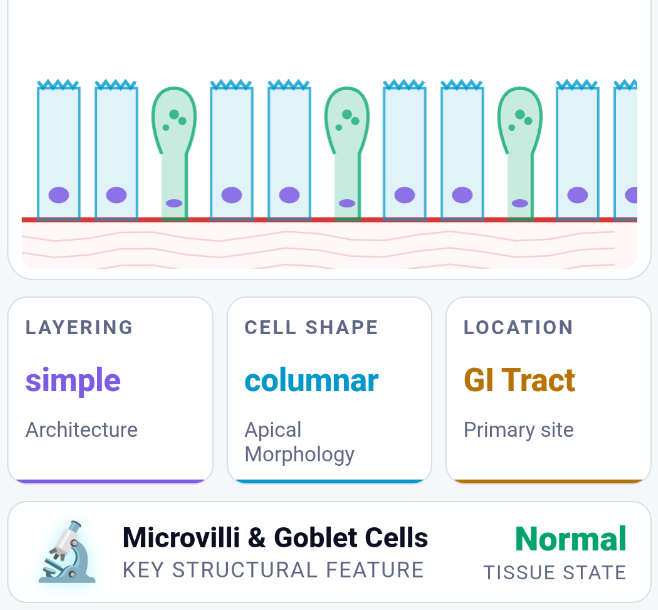
Identify tissue types on a live histology slide.
Adjust preload and watch the Frank-Starling curve respond.
Walk cyanide through the electron transport chain and see where it actually strikes.
Integrated, not bolted on.
Widgets live inside the learning cards — not in a separate section. When a card covers a concept that benefits from visualisation, here's how it shows up:
You hit a question mid-quiz or mid-flashcard.
Tap Learn More — widget opens alongside the definition and explanation.
Return with the mental model now built.
🎁 All 7 widgets below are completely free. No subscription required — try them on the free tier and get a feel for how widget-driven learning works before you commit to the bundle.
Here are the seven free widgets, grouped by subject. Each description answers "what will I actually be able to do after using this widget?" — widgets teach the mechanism and then hand you the clinical reasoning built on top. (Another 20 widgets are unlocked with the Pre-Clinicals bundle — see below.)
Anatomy
2 widgetsCranial Nerves
Master all 12 cranial nerves — function, exit foramen, and lesion patterns. Prepares you for viva classics: CN III palsy, Bell's palsy, jugular foramen syndrome, Wallenberg.
Histology Cell Layers
Recognise the major tissue types on a slide — simple vs stratified epithelia, connective tissue, muscle, nervous tissue. Core for 1st-year histology practicals and SBAs identifying tissue from a description.
Biochemistry
2 widgetsElectron Transport Chain
How mitochondria generate ATP and why specific poisons are lethal at each complex — cyanide (IV), carbon monoxide (IV), rotenone (I), oligomycin (ATP synthase), uncouplers (aspirin, 2,4-DNP). Anchors biochem + toxicology SBAs.
Vitamin Cofactor Map
Link each water-soluble vitamin to the reactions it enables: B1 → pyruvate DH + Wernicke; B6 → ALA synthase, sideroblastic anaemia, transaminases; B9/B12 → DNA synthesis, megaloblastic anaemia, neuropathy. Deficiency questions live here.
Physiology
3 widgetsAction Potential
How nerves and muscles fire — and why local anaesthetics, antiarrhythmics, and demyelinating disease (MS, Guillain-Barré) do what they do. The cellular foundation beneath every ECG, EEG, and nerve-conduction study.
Frank-Starling Curve
Why preload, afterload, and contractility change stroke volume — and how this explains heart failure, diuretic response, and inotrope choice in shock. Anchors CVS physiology + clinical cardiology reasoning.
Hypothalamus-Pituitary Axis
How hypothalamic releasing hormones drive pituitary output that drives peripheral endocrine glands — with the feedback loops that explain Addison, Cushing, hypogonadism, hypothyroidism, prolactinoma, and acromegaly. Foundational for every endocrine case.
Plus 20 more widgets unlocked with the bundle
The free widgets give you the feel. The full Pre-Clinicals bundle unlocks 20 more widgets — and new ones are released every week, driven by which concepts our Pre-Clinicals users flag as hardest.
Anatomy
+5 bundle widgetsBiochemistry
+6 bundle widgetsPhysiology
+9 bundle widgets27 widgets total (7 free + 20 bundle) — growing every week.
Spaced Repetition Built In
Because every learning card can be used as a flashcard, spaced repetition is built into the bundle by default. Our algorithm surfaces cards just as you're about to forget them — the most efficient way to build long-term memory of dense pre-clinical content.
This matters more for pre-clinicals than any other stage of medical school. You're not learning a concept once — you're building a foundation that has to stay solid through clinicals, boards, and residency. Spaced repetition is how you get material from "I understood it in lecture" to "I can recall it automatically three years from now."
The Old Way vs The New Way
| Before | Now on Tenkobo | |
|---|---|---|
| Cost for Anatomy + Physiology + Biochemistry | ~$12–$15/month (pay per subject) | $6/month (entire bundle) |
| Interactive visuals | None | 27 widgets (7 free + 20 in bundle), new ones added weekly |
| Flashcard system | Separate app, separate subscription | Built-in, spaced-repetition |
| Study group chat | Separate apps | Built-in (see Community Guidelines) |
| Mock exams | Buy textbook practice packs separately | Included in bundle |
How to Get Started
Free tier: every pre-clinical student can browse the full catalogue, preview questions across Anatomy, Physiology, and Biochemistry, and play 2 Arena games per day at no cost.
Pre-Clinicals bundle ($6/month): unlocks the full question banks, all mock exams, unlimited flashcards, and every interactive widget for Anatomy, Physiology, and Biochemistry. Monthly and quarterly plans available.
All-in-One: if you're also preparing for USMLE-adjacent or career topics (Get Hired, IT Networking, etc.), the All-in-One bundle covers all 49 subjects across every tier-group. See pricing for the full breakdown.
A note on pricing: Prices shown are the web reference price. Users on iOS and Android may see slightly different prices in their app stores because Apple and Google charge service fees. Web pricing (Stripe / Paystack / Flutterwave — coming soon) will be closest to the values shown here.
Pre-Clinicals Shouldn't Be About Memorising in Isolation
The students who get through pre-clinicals strongest aren't the ones who read the most pages — they're the ones who understood the mechanism. Widgets exist for that reason. Spaced repetition exists for that reason. Affordable, bundled access exists so you don't have to choose between subjects based on what you can afford to subscribe to.
Download Tenkobo, start on the free tier, and upgrade to the Pre-Clinicals bundle when you're ready.
Tags:
Start Your Academic Success Journey Today
Join thousands of students across Africa using Tenkobo to achieve their academic goals and build career-ready skills.
Related Articles
Spring 2026: A Bigger, Smarter Tenkobo
25 subjects across academic exams, medical pre-clinicals, and professional certifications (CFA, PMP, ICAN, ACCA & more). Plus Chat, Study Groups, smarter 14-day trials, and Season 1 prizes.
The West African Education Crisis: Nigeria and Ghana's Parallel Struggles
From UTME to WASSCE, exam results across West Africa reveal a systemic education crisis. Coming soon.
₦1.9M / GH₵15.7K on the Table — Six Ways to Win Season 1
The full ≈ ₦1.9 million Season 1 prize structure — every prize, every threshold, every formula, with worked examples. Six ways to win. Snapshot 31 May 2026.